
Energy management for a distribution centre: cooling, charging infrastructure and peaks in view
Direct answer
Energy management for a distribution centre brings cooling, lighting, charging infrastructure and peak load together in one central control view. The biggest cost risks often arise from simultaneous charging and cooling, which makes peak load and contracted capacity more decisive than total consumption.
- Cooling, lighting and charging infrastructure in one view
- Track peak load and simultaneity
- Monitor contracted capacity and grid capacity
- Cost impact made visible per process
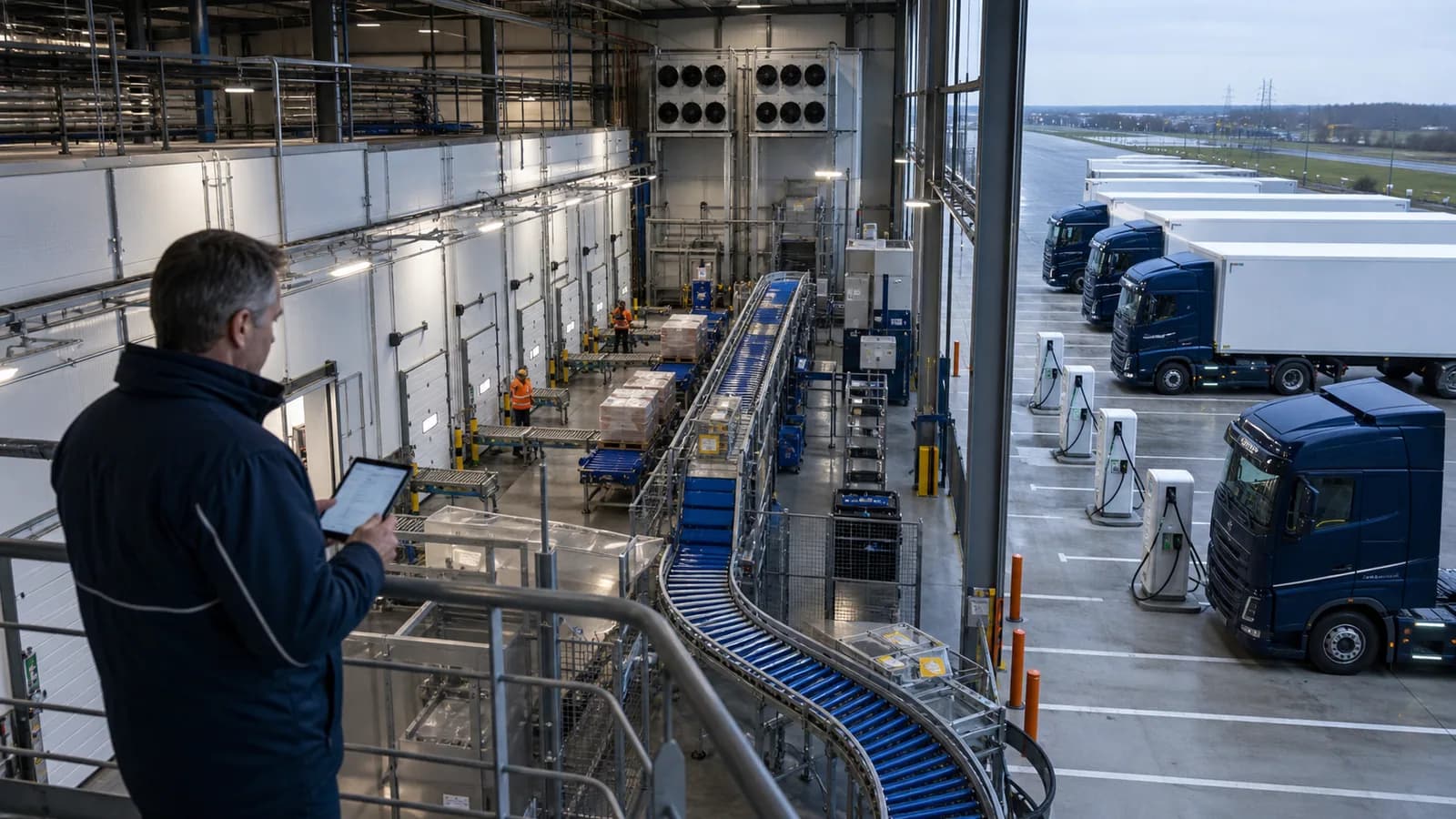
Standalone meters versus energy management for a DC
Distribution centres combine cooling, lighting, automation and increasingly charging infrastructure for electric vehicles. As a result, the challenge shifts from total consumption to simultaneity and peak load. Energy management makes visible when peaks arise, what they cost and how charging and cooling influence each other, so decisions are well-founded.
Key points
Overview
Traditional approach
View cooling, charging and lighting separately.
Modern approach
All processes in one central control view.
Peaks
Traditional approach
Only visible on the invoice.
Modern approach
Recognise simultaneous charging and cooling in advance.
Decision
Traditional approach
Adjust reactively.
Modern approach
Spread charging on a sound basis or review contracted capacity.
Why peak load works differently in a DC
In a distribution centre, cooling and charging infrastructure can peak at the same time, especially during fast charging of electric trucks. That simultaneity drives up contracted capacity.
- Analyse charging and cooling peaks together.
- Link simultaneity to contracted capacity.
- Spread charging moments where possible.
- Detect grid capacity risk early.
Which data sources help?
Quarter-hour values from the main meter provide a solid foundation. Submetering on cooling or charging infrastructure deepens the picture where needed.
- Quarter-hour values for electricity.
- Submetering on cooling, charging and lighting.
- Contracted capacity and grid capacity as context.
- Alerts on atypical night-time consumption and data quality.
Curious what this looks like with your own data?
In a no-obligation call, a specialist looks at your meters, sites and energy questions with you. Response within one business day.
Where this adds value directly
Charging
Spread charging moments and limit simultaneous peaks.
Cooling
Track cooling consumption and deviations per period.
Portfolio
Compare multiple DC locations in one overview.
Frequently asked questions
Practical answers to common questions about this topic.
Question not covered here?
Ask a specialist directly. You will get a response within one business day.
Ask your questionIs energy management needed if I still have little charging infrastructure?
That is precisely when it is valuable. Forward-looking insight shows how much headroom there is in the contracted capacity before you expand charging points, so you avoid unexpected overruns.
What does energy management for a distribution centre cost?
The model is modular and indicative: Consumption Analysis at a fixed price per meter per month as a base, expandable with Financial Analysis and Capacity Analysis (each at a fixed surcharge per meter). For charging infrastructure and assets, Asset Management (fixed monthly price) can be added separately, as can Congestion Management (fixed monthly price) where grid capacity is tight. The exact scope follows after an intake call.
What is the core of energy management distribution centre?
Energy management for a distribution centre brings cooling, lighting, charging infrastructure and peak load together in one central control view. The biggest cost risks often arise from simultaneous charging and cooling, which makes peak load and contracted capacity more decisive than total consumption.
What data do I need for energy management distribution centre?
Start with quarter-hour meter data, invoices, contract data and site characteristics. That makes energy management distribution centre concrete, comparable and easier to follow up, rather than just a separate report.
When does this topic become relevant for my organisation?
As soon as it touches costs, grid capacity, reporting or daily operations. Also consider related themes such as energy management DC, energy consumption distribution centre and charging infrastructure distribution centre energy.
Series · Sector-specific software
All 20 articlesSearch the knowledge base
Find the answer to your question.
Search using your own words. Abbreviations and spelling variants are recognised, so EMS also finds the articles on energy management systems.
Topic
Useful next steps
Curious what this means for your organisation?
Book a no-obligation call and discover it with your own energy data.