
Hospitality
Article 3 of 20 · Sector-specific softwareEnergy management for hospitality: what should you look out for?
Direct answer
Energy management for hospitality revolves around night consumption, refrigeration, kitchen peaks, opening hours and differences between sites. Especially across multiple locations, central monitoring is valuable because deviations become visible quickly.
- Night consumption and refrigeration
- Recognise kitchen peaks
- Compare locations
- Track costs per period
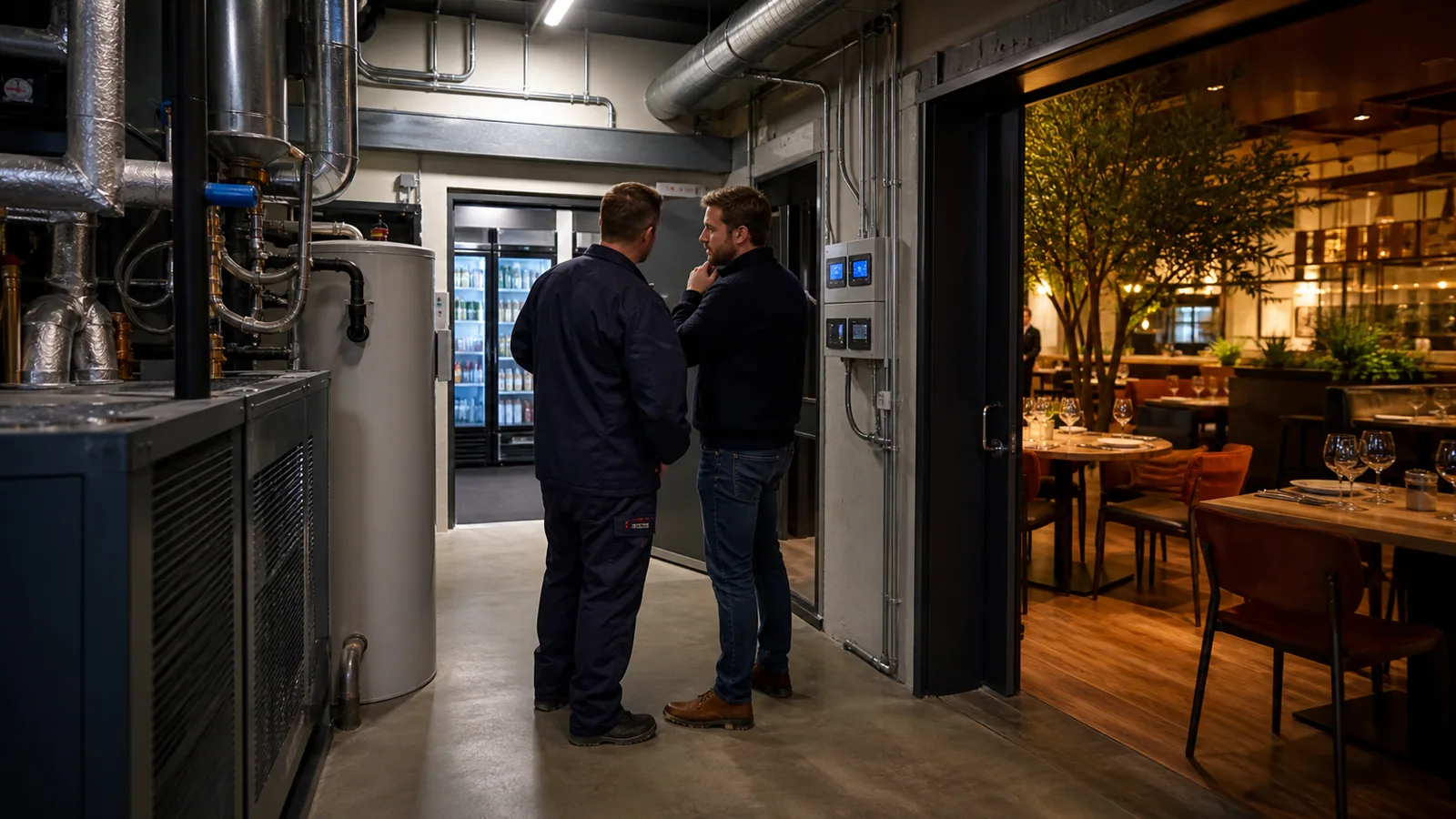
General dashboard versus hospitality energy management
Hospitality has a recognisable but erratic energy profile. Refrigeration runs constantly, kitchen equipment peaks during busy moments and night consumption often stays unnoticeably high. Good energy management makes those patterns visible without making operations more complicated.
Key points
Context
Traditional approach
Total consumption without opening hours.
Modern approach
Consumption linked to daily rhythm, kitchen and refrigeration.
Deviations
Traditional approach
High costs are noticed after the fact.
Modern approach
Night consumption and standby load become visible early.
Chain
Traditional approach
Locations report separately.
Modern approach
Sites are compared centrally and fairly.
What are the biggest points of attention?
The biggest opportunities often lie in refrigeration, HVAC, kitchen equipment, boilers, lighting, night consumption and settings that stay active outside opening hours.
- Monitor refrigeration and freezer installations.
- Recognise peaks around mise en place and service.
- Check night and weekend consumption.
- Track costs per location or period.
When does central software make sense?
Central software makes sense with multiple locations, high energy costs, a lot of manual work or when managers need to act on deviations quickly.
- Compare multiple hospitality venues.
- Set alerts per location.
- Reporting to finance or chain management.
- Make the effect of measures visible.
Curious what this looks like with your own data?
In a no-obligation call, a specialist looks at your meters, sites and energy questions with you. Response within one business day.
Where this adds value directly
Refrigeration
Monitor continuous load and deviations.
Costs
Link consumption to energy costs.
Chain
Compare locations centrally.
Frequently asked questions
Practical answers to common questions about this topic.
Question not covered here?
Ask a specialist directly. You will get a response within one business day.
Ask your questionIs energy management also useful for a single hospitality venue?
Yes, especially with high night consumption, a lot of refrigeration or unexplained costs. For chains, the value grows through location comparison.
Where do I start in hospitality?
Start with night consumption, refrigeration, peaks around opening hours and a simple monthly report.
What is the core of energy management hospitality?
Energy management for hospitality revolves around night consumption, refrigeration, kitchen peaks, opening hours and differences between sites. Especially across multiple locations, central monitoring is valuable because deviations become visible quickly.
What data do I need for energy management hospitality?
Start with quarter-hour meter data, invoices, contract data and site characteristics. That makes energy management hospitality concrete, comparable and easier to follow up, rather than just a separate report.
When does this topic become relevant for my organisation?
As soon as it touches costs, grid capacity, reporting or daily operations. Also consider related themes such as energy management hospitality, energy monitoring hospitality and hospitality energy costs.
Series · Sector-specific software
All 20 articlesSearch the knowledge base
Find the answer to your question.
Search using your own words. Abbreviations and spelling variants are recognised, so EMS also finds the articles on energy management systems.
Topic
Useful next steps
Curious what this means for your organisation?
Book a no-obligation call and discover it with your own energy data.