
Energy monitoring for production companies: from measurement data to a steering view
Direct answer
Energy monitoring for production makes visible how much energy processes, lines and machines consume, when peaks arise and what that costs. Tracking total consumption alone is usually insufficient, because it is precisely process profiles and simultaneity that determine costs and capacity.
- Consumption per process and period
- Track peak load and contracted capacity
- Recognise baseload consumption outside production time
- Put cost impact on the table
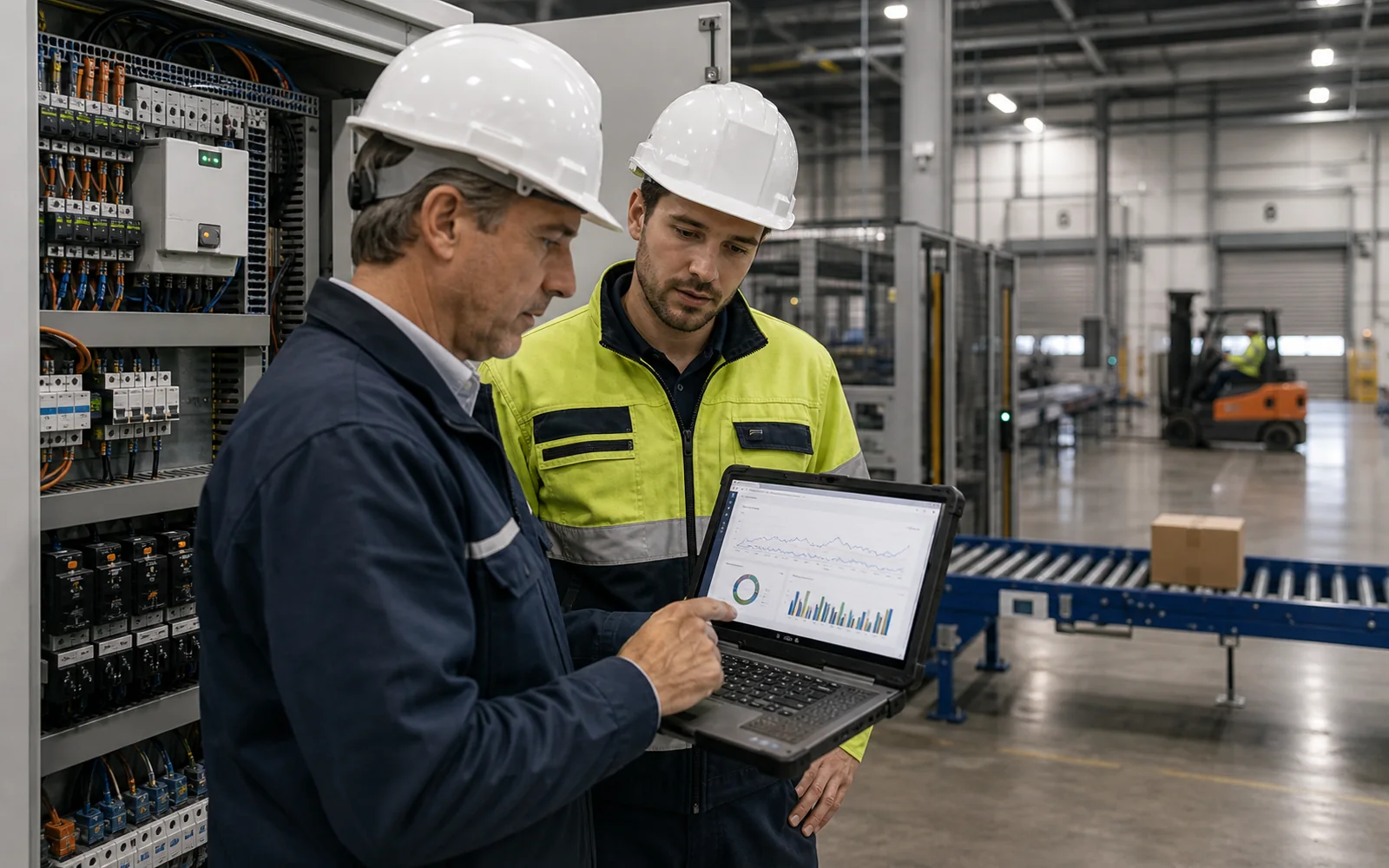
Supplier portal versus energy monitoring for production
Production companies often already have measurement data via smart meters or a supplier portal, but do not see which process or line causes a cost item. Energy monitoring brings structure: what consumes when, why does it deviate and which next step is logical? That makes it relevant for operations, finance and management at the same time.
Key points
Focus
Traditional approach
Total consumption per month.
Modern approach
Consumption per process, line and peak moment.
Data
Traditional approach
Invoice and monthly values.
Modern approach
Quarter-hour values with production context.
Output
Traditional approach
Reporting after the fact.
Modern approach
Signals, deviations and concrete next steps.
What makes energy monitoring different for production?
In production, processes, shifts and simultaneity determine the consumption profile. Monitoring must be able to explain that profile rather than only show a total.
- Link quarter-hour values to production planning.
- Connect peaks to simultaneous processes.
- Track down baseload consumption outside production time.
- Make costs per profile transparent.
When is submetering needed?
Main meter data is often sufficient for an initial analysis. Submetering becomes relevant once process or machine consumption cannot be explained from the main meter.
- Start with smart meter and quarter-hour data.
- Add submetering where processes deviate inexplicably.
- Substantiate investments in measurement points with insight.
- Keep the measurement structure supplier-independent.
Curious what this looks like with your own data?
In a no-obligation call, a specialist looks at your meters, sites and energy questions with you. Response within one business day.
Where this adds value directly
Process
Connect consumption with production planning and shifts.
Peaks
Analyse peak load and contracted capacity.
Costs
Put cost impact per process on the table.
Frequently asked questions
Practical answers to common questions about this topic.
Question not covered here?
Ask a specialist directly. You will get a response within one business day.
Ask your questionDo I need a meter per machine to get started?
No. For an initial analysis, smart meter and quarter-hour data is often sufficient. You add submetering per line or machine later, where it yields insight.
What does energy monitoring for production cost?
The model is modular and indicative: Consumption Analysis at a fixed price per meter per month as a base, optionally expandable with Financial Analysis and Capacity Analysis (each at a fixed surcharge per meter). Asset Management and Congestion Management (each at a fixed monthly price) can be added separately. The exact scope is determined after an intake call.
What is the core of energy monitoring production?
Energy monitoring for production makes visible how much energy processes, lines and machines consume, when peaks arise and what that costs. Tracking total consumption alone is usually insufficient, because it is precisely process profiles and simultaneity that determine costs and capacity.
What data do I need for energy monitoring production?
Start with quarter-hour meter data, invoices, contract data and site characteristics. That makes energy monitoring production concrete, comparable and easier to follow up, rather than just a separate report.
When does this topic become relevant for my organisation?
As soon as it touches costs, grid capacity, reporting or daily operations. Also consider related themes such as energy monitoring production company, measure energy consumption production process and energy dashboard production.
Series · Sector-specific software
All 20 articlesSearch the knowledge base
Find the answer to your question.
Search using your own words. Abbreviations and spelling variants are recognised, so EMS also finds the articles on energy management systems.
Topic
Useful next steps
Curious what this means for your organisation?
Book a no-obligation call and discover it with your own energy data.