
For building portfolios and central managers
Real estate & multi-site
Compare buildings, locations and meters. Ideal for portfolios where data is spread across supplier portals and Excel.
Pricing model
Modular per meter, confirmed after scope
Start with Consumption Analysis per meter. You only add Financial Analysis and Capacity Analysis when they add value.
 Real estate & multi-site
01
The approach
From recognizable situations to concrete data questions.
02
Sector profile
Quarter-hour values reveal peaks and baseload consumption.
03
Where the money is
Cost, capacity and anomalies come together in an action view.

The approach
One measurement foundation under the entire portfolio.
Real estate management runs on comparability: being able to set buildings, tenants and installations side by side. COMCAM lays the same data foundation under every square metre, so decisions on maintenance, tenants and decarbonisation rest on measurements rather than assumptions.
Recognise
Per building it becomes visible what keeps running at night and at the weekend. An empty building should consume next to nothing.
Compare
Buildings with the same function and size are set side by side per square metre. The outliers determine where attention pays off.
Steer
Controls are tuned to the profile, and investments in heat pumps, solar or charging infrastructure are sized to what genuinely fits.
Where real estate & multi-site often runs into trouble.
Energy Intelligence is positioned differently for each sector. The value lies in recognisable situations, not in generic dashboards.
No central overview
Many locations
No benchmark available
Reporting takes time
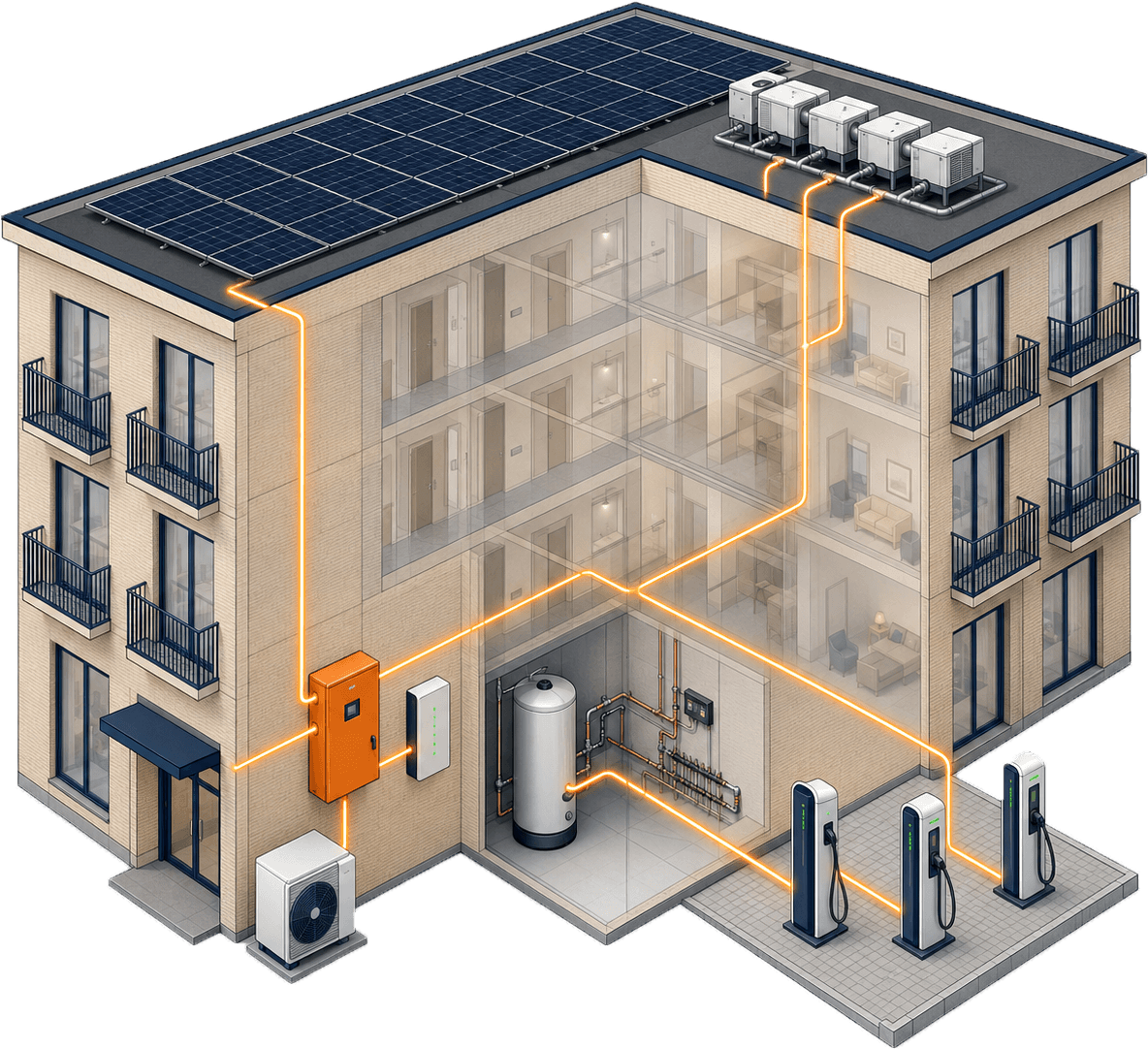
The energy model
Real estate & multi-site
Where consumption, generation and steering come together in this sector: from meters and cooling to solar panels and charging infrastructure.
Sector profile
The office profile: steady during the day, but the start-up and the night tell the real story.
Day profile in quarter-hour valuesNight-time baseload
Systems running in an empty building: ventilation, pumps, servers. The first place to look.
Simultaneous start-up
HVAC systems all kicking in at 7:00 set the highest peak of the day, often needlessly.
Daytime plateau
Occupancy and consumption should move together. A full plateau at half occupancy is a tuning question.
Contracted capacity
Adding charge points and heat pumps? The profile shows the real headroom per building.
Where the money is
Three insights that make the difference in real estate & multi-site.
An empty building should consume next to nothing
Night and weekend consumption as a share of the total is the key steering variable in real estate. Structurally high night consumption means misconfigured controls, not a behaviour problem.
Portfolio-wide comparison finds the outliers
Buildings with comparable function and floor area should perform comparably per square metre. The outliers determine where maintenance and investment pay off.
Decarbonisation starts with the profile, not the building envelope
Sizing a heat pump, solar panels or charging infrastructure without quarter-hour values is gambling with the connection. The profile determines what fits, and where grid congestion will start to bite.
From the field · Real estate
Landlord passes energy costs on to tenants
The landlord of a restaurant with (private) subletting wants insight into consumption in order to pass costs on to tenants correctly.
View all casesResult
Consumption per tenant visible for correct cost allocation.
Energy Intelligence for real estate & multi-site.
Start with Consumption Analysis per meter. You only add Financial Analysis and Capacity Analysis when they add value.
Consumption Analysis
Base rate per meter for consumption, locations and trends.
Book a no-obligation callRead on in the knowledge base.
In-depth articles on exactly these questions: substantiation, practical examples and step-by-step plans.

Sector: Real estate
Energy management for real estate: control over consumption, costs and portfolio
Energy management for real estate with COMCAM brings consumption, costs and peak load of each building together in a central, supplier-independent overview. You compare buildings fairly, recognise deviations and steer portfolio-wide on savings and sustainability.
Read article

Sector: Real estate
Energy data in real estate management: from separate meters to a central view
Energy data in real estate management only becomes valuable when separate meters, buildings and tenants come together in a central, controllable view. COMCAM connects that data supplier-independently, so you can steer, compare and report on consumption and costs in a well-founded way.
Read article

Sector: Real estate
Energy data for GRESB and ESG reporting: your portfolio demonstrably on track
GRESB and ESG reporting stands or falls with the underlying energy data: per asset, per meter and where possible per tenant, traceable back to source. COMCAM records that data continuously and supplier-independently, so data coverage is no longer an annual surprise and like-for-like comparisons hold up. You use the same data foundation all year round to steer the portfolio, not just to report after the fact.
Read article
Frequently asked questions about energy insight in real estate & multi-site.
From metering data and savings opportunities to capacity, regulation and a practical start.
01Where is the first measurable saving opportunity in real estate & multi-site?
An empty building should consume next to nothing. Night and weekend consumption as a share of the total is the key steering variable in real estate. Structurally high night consumption means misconfigured controls, not a behaviour problem.
02Which deviations and decisions become visible through comparison in real estate & multi-site?
Portfolio-wide comparison finds the outliers. Buildings with comparable function and floor area should perform comparably per square metre. The outliers determine where maintenance and investment pay off.
03Which strategic decision can the energy profile substantiate?
Decarbonisation starts with the profile, not the building envelope. Sizing a heat pump, solar panels or charging infrastructure without quarter-hour values is gambling with the connection. The profile determines what fits, and where grid congestion will start to bite.
04Which patterns appear in the energy profile of real estate & multi-site?
Night-time baseload: Systems running in an empty building: ventilation, pumps, servers. The first place to look. Simultaneous start-up: HVAC systems all kicking in at 7:00 set the highest peak of the day, often needlessly.
05How does capacity analysis support expansion or electrification?
Adding charge points and heat pumps? The profile shows the real headroom per building. COMCAM compares quarter-hour values with contracted capacity, so additional demand can be assessed before investment decisions are made.
06Which energy data does COMCAM need for real estate & multi-site?
The foundation consists of quarter-hour values per meter and location. Where available, COMCAM adds gas data, contracted capacity, tariffs, operating hours and relevant asset data. Access is arranged through authorisation or an existing data connection.
07Are additional sensors or submeters always required?
No. Existing smart meters and telemetry data are the logical starting point. Submetering is only added where the main profile cannot answer a specific process question with sufficient precision.
08Which Dutch energy-saving obligations may apply to a location?
In the Netherlands, the energy-saving obligation currently applies from 50,000 kWh of electricity or 25,000 m³ of natural-gas equivalent per location per year. Measures with a payback period of no more than 5 years must be implemented. An extension to 7 years is intended for 1 July 2027, but the five-year threshold remains in force until the change is final. The exact obligation depends on the location, use and activity.

Get in touch
Let your energy data work for you.
Book a no-obligation call. We discuss your energy question, look at your own metering data and whether structural insight adds value.
- Response within one working day
- Dashboard with your own data
- Supplier-independent
- No commitments