
Grid congestion
Article 1 of 14 · Monitoring, grid capacity and valueHow do I solve grid congestion on my business park?
Direct answer
Grid congestion on a business park is not solved with a heavier connection alone. The first step is insight into peaks, simultaneity, contracted capacity, charging profiles and flexibility per business. You can then explore measures such as spreading, control, storage, energy hub agreements or contract optimisation.
- Start with peak and profile analysis
- Look at simultaneity per business
- Substantiate energy hub and flexibility
- Put contracted capacity on the table
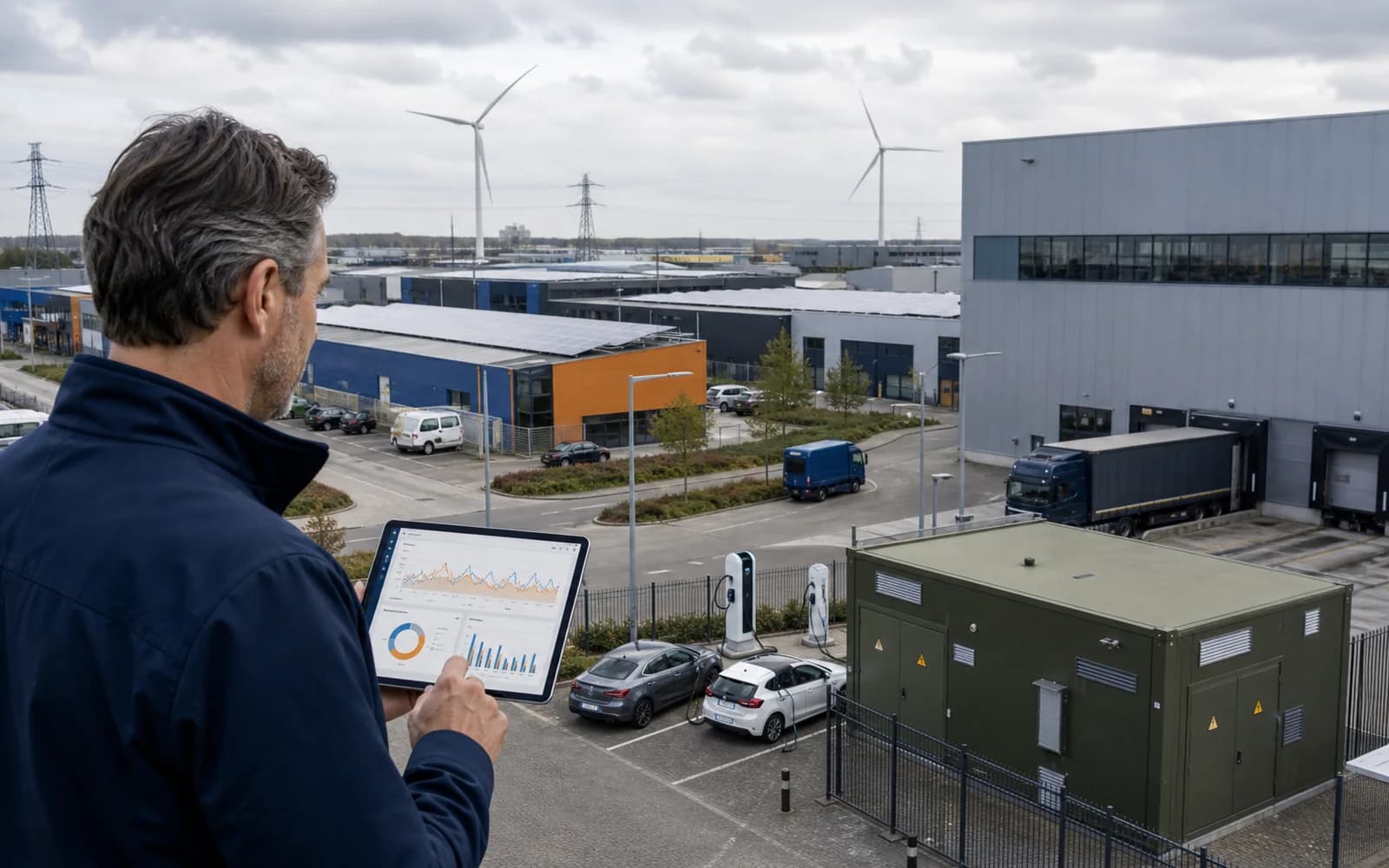
Grid reinforcement versus data-driven capacity management
Grid congestion is often discussed as a technical problem, but for a business park the solution starts with data and collaboration. Without insight into profiles and peaks, it is hard to determine whether flexibility, storage, contract adjustment or collective control make sense.
Key points
Starting point
Traditional approach
Waiting for grid reinforcement or extra capacity.
Modern approach
Insight into current peaks, profiles and simultaneity.
Measure
Traditional approach
Choosing a technical solution without a complete picture.
Modern approach
First determining where flexibility or spreading is possible.
Collaboration
Traditional approach
Each business looks at its own connection.
Modern approach
The business park looks at collective capacity and agreements.
Decision
Traditional approach
Based on scarcity and assumptions.
Modern approach
Based on measured data, scenarios and priorities.
What data do you need?
For grid congestion, quarter-hour values, contracted capacity, peak moments, charging profiles, production profiles and site context are important. On business parks, simultaneity between businesses is added.
- Quarter-hour values per connection.
- Contracted capacity and maximum peak load.
- Charging infrastructure, production, cooling or process profiles.
- Simultaneity between businesses and buildings.
Which solutions can you explore?
Solutions differ per site. Think of peak spreading, smart charging control, storage, local generation, energy hub agreements, group contracts or operational planning.
- Spread peaks across parts of the day.
- Plan charging moments intelligently.
- Assess flexibility and storage financially.
- Make agreements between businesses on the site.
What can Energy Intelligence (by COMCAM) do?
The platform helps make peaks, profiles and risks visible. This creates a factual basis for conversations with entrepreneurs, the grid operator, advisers and technical parties.
- Capacity analysis per site or connection.
- Portfolio overview for site or property.
- Signals on peak load and anomalies.
- Input for follow-up advice and measures.
Curious what this looks like with your own data?
In a no-obligation call, a specialist looks at your meters, sites and energy questions with you. Response within one business day.
Where this adds value directly
Peak analysis
See when capacity is actually used.
Collective view
Compare connections and sites on the same park.
Scenarios
Substantiate conversations about spreading, storage and control.
Frequently asked questions
Practical answers to common questions about this topic.
Question not covered here?
Ask a specialist directly. You will get a response within one business day.
Ask your questionCan software solve grid congestion?
Software does not solve grid congestion physically, but makes visible where capacity is used and where control is possible. That is often the first necessary step.
What is simultaneity in grid congestion?
Simultaneity means several businesses or installations demand a lot of power at the same time. If peaks do not coincide, capacity can sometimes be used more cleverly.
Is this relevant for an individual business?
Yes. An individual business can also analyse peaks, contracted capacity and charging profiles. On a business park, the value grows when multiple parties combine data.
What is the core of solve grid congestion business park?
Grid congestion on a business park is not solved with a heavier connection alone. The first step is insight into peaks, simultaneity, contracted capacity, charging profiles and flexibility per business. You can then explore measures such as spreading, control, storage, energy hub agreements or contract optimisation.
What data do I need for solve grid congestion business park?
Start with quarter-hour meter data, invoices, contract data and site characteristics. That makes solve grid congestion business park concrete, comparable and easier to follow up, rather than just a separate report.
When does this topic become relevant for my organisation?
As soon as it touches costs, grid capacity, reporting or daily operations. Also consider related themes such as grid congestion businesses, peak load business park and energy hub business park.
Series · Monitoring, grid capacity and value
All 14 articlesSearch the knowledge base
Find the answer to your question.
Search using your own words. Abbreviations and spelling variants are recognised, so EMS also finds the articles on energy management systems.
Topic
Useful next steps
Curious what this means for your organisation?
Book a no-obligation call and discover it with your own energy data.