
Congestion management
Article 14 of 14 · Monitoring, grid capacity and valueCongestion management on a business park: where do you begin?
Direct answer
Congestion management on a business park is about smartly distributing and spreading the available grid capacity between businesses. It starts not with technology, but with insight: which peaks arise when, how large is the simultaneity, and where is the flexibility? COMCAM makes that visible per connection and for the entire site.
- Peaks and simultaneity per connection
- Collective capacity picture for the site
- Underpin flexibility and spreading
- Factual basis for agreements and conversations
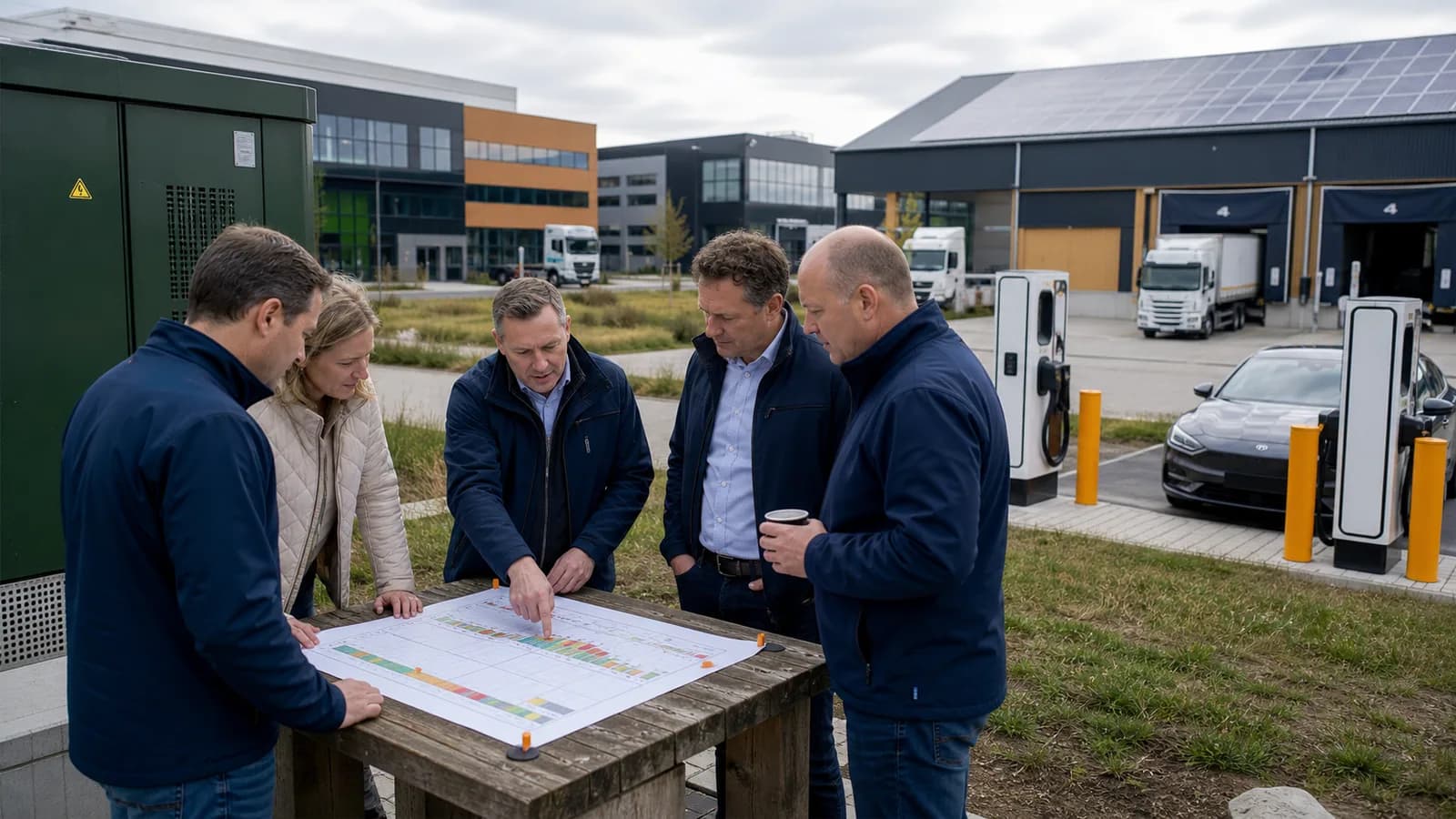
Waiting for grid reinforcement versus active congestion management
On more and more business parks, expanding the connection is not quickly possible. Congestion management then offers room: by spreading peaks and using flexibility, the existing capacity can be shared more effectively. The condition is a shared, data-driven picture of who requests how much power and when.
Key points
Starting point
Traditional approach
Waiting for extra capacity or a heavier connection.
Modern approach
Insight into current peaks, profiles and simultaneity.
Approach
Traditional approach
Each business optimises independently of its neighbours.
Modern approach
The site distributes and spreads capacity collectively.
Substantiation
Traditional approach
Assumptions about consumption and peaks.
Modern approach
Measurement data, simultaneity analysis and scenarios.
Result
Traditional approach
Standstill until the grid is reinforced.
Modern approach
More room within the existing capacity.
What is congestion management on a business park?
Congestion management means that businesses coordinate their power demand among themselves so that peaks do not all occur at once. As a result, the available grid capacity can be used more effectively without everyone waiting for grid reinforcement.
- Spread peaks across times of day and businesses.
- Deliberately deploy or shift flexible installations.
- Lower simultaneity where operationally possible.
- Make agreements on distributing available power.
What data do you need to start?
The basis is a reliable picture of consumption and peaks per connection. On a site, the simultaneity between businesses is added: do peaks coincide or not?
- Quarter-hour values per connection or business.
- Contracted capacity and maximum peak load.
- Charging, production and cooling profiles.
- Simultaneity between connections on the site.
What does COMCAM do for the site?
COMCAM makes peaks, profiles and simultaneity visible per connection and for the entire site. This creates a factual basis for agreements with entrepreneurs, grid operator and advisers. COMCAM is supplier-independent and does not control any installations; it provides the insight on which you choose measures.
- Capacity analysis per connection.
- Portfolio overview for the entire site.
- Signals on peak load and anomalies.
- Input for flexibility and spreading agreements.
Curious what this looks like with your own data?
In a no-obligation call, a specialist looks at your meters, sites and energy questions with you. Response within one business day.
Where this adds value directly
Simultaneity
See whether businesses' peaks coincide or can be spread.
Collective picture
Compare connections on the same site.
Substantiation
Hold conversations about distribution based on data.
Frequently asked questions
Practical answers to common questions about this topic.
Question not covered here?
Ask a specialist directly. You will get a response within one business day.
Ask your questionDoes congestion management fully solve grid congestion?
Not always fully, but it can free up a lot of room within the existing capacity. By spreading peaks and using flexibility, more is often possible, either without grid reinforcement or while awaiting it.
What is simultaneity and why is it important?
Simultaneity means that several businesses request a lot of power at the same moment. If those peaks do not coincide, the shared capacity can be distributed more intelligently. Insight into simultaneity is therefore the core of congestion management.
Does every business on the site need measurement data?
The value grows as more businesses contribute their data. Even with a portion of the connections a useful picture already emerges; with full participation the collective capacity picture becomes strongest.
What is the core of congestion management business park?
Congestion management on a business park is about smartly distributing and spreading the available grid capacity between businesses. It starts not with technology, but with insight: which peaks arise when, how large is the simultaneity, and where is the flexibility? COMCAM makes that visible per connection and for the entire site.
What data do I need for congestion management business park?
Start with quarter-hour meter data, invoices, contract data and site characteristics. That makes congestion management business park concrete, comparable and easier to follow up, rather than just a separate report.
When does this topic become relevant for my organisation?
As soon as it touches costs, grid capacity, reporting or daily operations. Also consider related themes such as congestion management businesses, collective congestion management and flexibility business park.
Series · Monitoring, grid capacity and value
All 14 articlesSearch the knowledge base
Find the answer to your question.
Search using your own words. Abbreviations and spelling variants are recognised, so EMS also finds the articles on energy management systems.
Topic
Useful next steps
Curious what this means for your organisation?
Book a no-obligation call and discover it with your own energy data.