
Energy monitoring across multiple locations: how do you get it right?
Direct answer
Energy monitoring across multiple locations requires a central structure for sites, meters, energy carriers, costs and responsibilities. After that you can benchmark, flag deviations and automate reports.
- Central portfolio overview
- Benchmark locations
- Alerts per site
- Management reporting
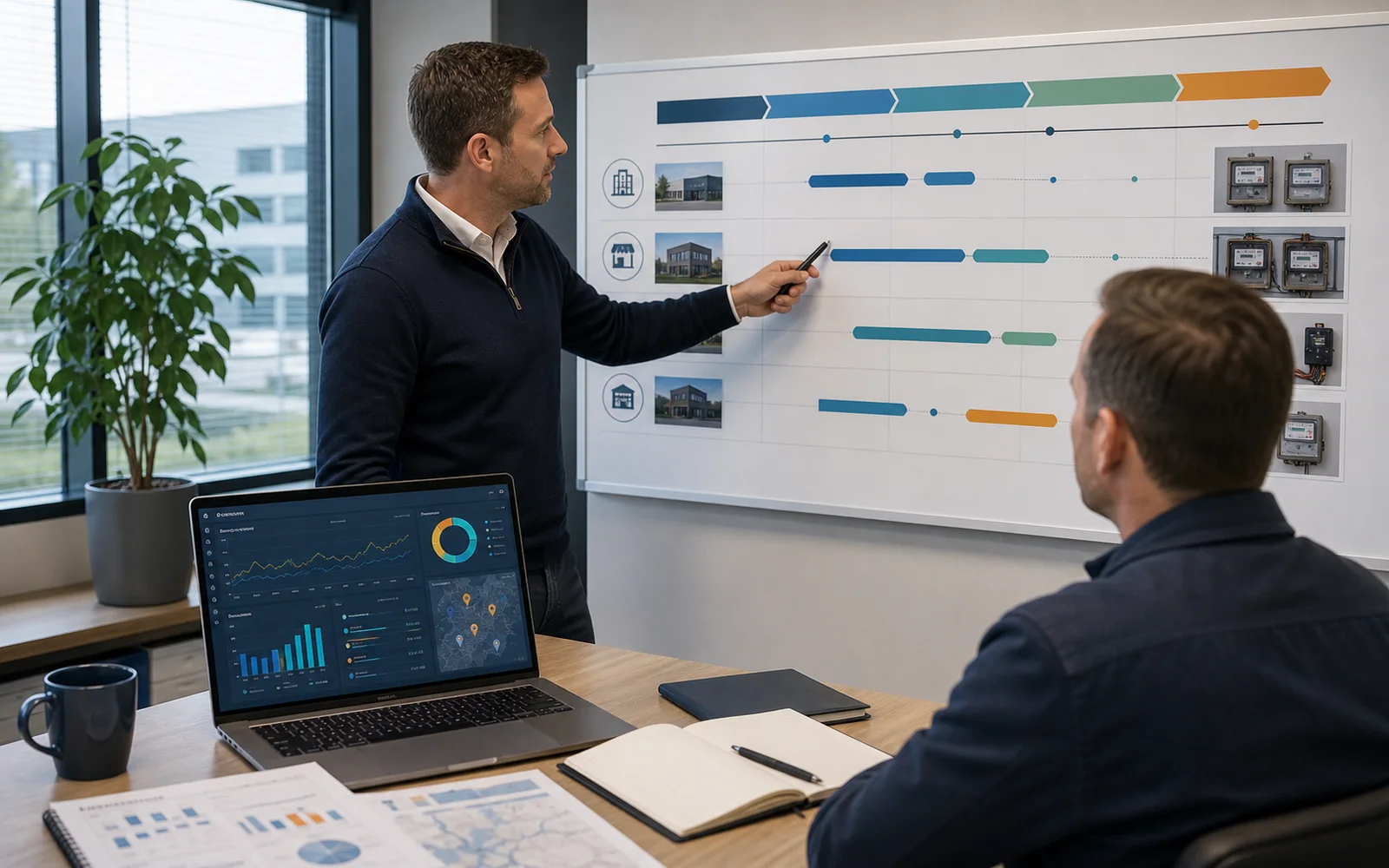
Isolated site view versus central energy monitoring
With multiple locations, energy data quickly scatters across portals, invoices and spreadsheets. Central energy monitoring ensures finance, facility and management work from the same picture.
Key points
Overview
Traditional approach
Each location has its own portal or spreadsheet.
Modern approach
All locations sit in a central energy portfolio.
Benchmark
Traditional approach
Total consumption is compared in isolation.
Modern approach
Locations are compared with appropriate context.
Follow-up
Traditional approach
Deviations stay local or invisible.
Modern approach
Alerts and reports make priorities clear.
What basics need to be in place?
Set up a location hierarchy, connection and meter information, data connections, a cost structure and agreements on follow-up.
- Structure locations and meters.
- Link metering data and invoice data.
- Check data quality.
- Assign owners per location.
How do you avoid wrong benchmarks?
Only compare locations fairly when you account for floor area, opening hours, occupancy, production, climate or other relevant drivers.
- Cluster comparable locations.
- Normalise on relevant KPIs.
- Check for missing data.
- Use deviations as a starting point for analysis.
Curious what this looks like with your own data?
In a no-obligation call, a specialist looks at your meters, sites and energy questions with you. Response within one business day.
Where this adds value directly
Portfolio
Bundle all locations and meters.
Benchmark
Compare sites fairly.
Alerts
Let deviations stand out automatically.
Frequently asked questions
Practical answers to common questions about this topic.
Question not covered here?
Ask a specialist directly. You will get a response within one business day.
Ask your questionCan this work with different suppliers?
Yes. That is exactly when an independent energy platform is useful, because data from multiple sources is centralised.
Do all locations have to be connected at once?
No. You can start with the most important locations and then expand in phases.
What is the core of energy monitoring multiple locations?
Energy monitoring across multiple locations requires a central structure for sites, meters, energy carriers, costs and responsibilities. After that you can benchmark, flag deviations and automate reports.
What data do I need for energy monitoring multiple locations?
Start with quarter-hour meter data, invoices, contract data and site characteristics. That makes energy monitoring multiple locations concrete, comparable and easier to follow up, rather than just a separate report.
When does this topic become relevant for my organisation?
As soon as it touches costs, grid capacity, reporting or daily operations. Also consider related themes such as energy monitoring multiple sites, multi-location energy monitoring and energy dashboard multiple locations.
Series · Choosing platforms and providers
All 13 articlesSearch the knowledge base
Find the answer to your question.
Search using your own words. Abbreviations and spelling variants are recognised, so EMS also finds the articles on energy management systems.
Topic
Useful next steps
Curious what this means for your organisation?
Book a no-obligation call and discover it with your own energy data.