
Data integration
Article 10 of 13 · Choosing platforms and providersHow do I link energy data from different sources?
Direct answer
You link energy data from different sources by first creating a fixed data structure for locations, meters, energy carriers and time periods. You then connect metering data, invoices, contracts, building data, charging station data and external sources via exports, APIs or data connections.
- Set up a data model
- Link APIs and exports
- Monitor data quality
- Combine costs and consumption
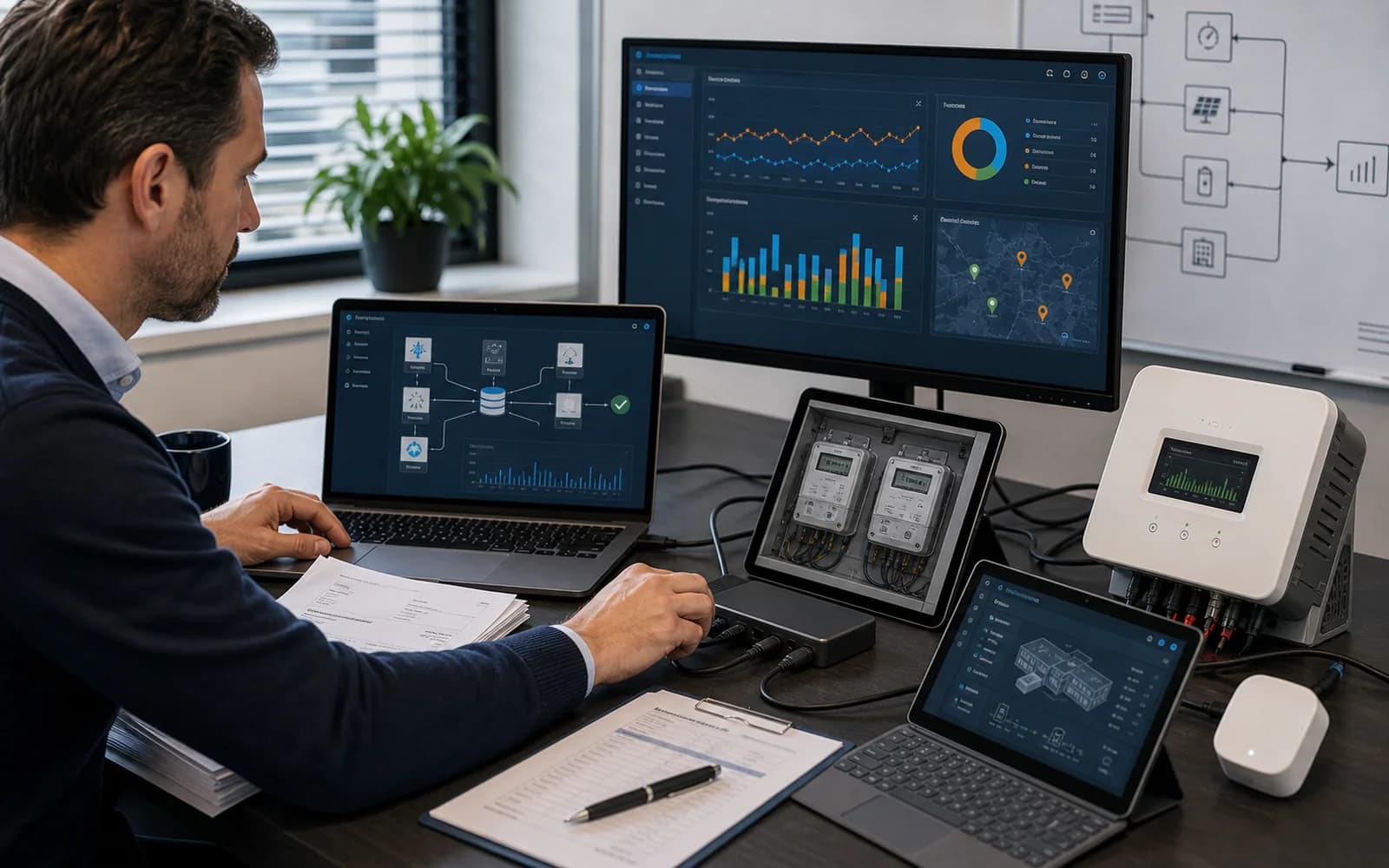
Separate data sources versus an energy data layer
Energy insight only becomes truly powerful when several sources come together. Metering data explains consumption, invoices explain costs, contracts explain risks and operational data explains why patterns arise. Without a data structure, that quickly becomes unclear.
Key points
Structure
Traditional approach
Each source has its own columns, time periods and definitions.
Modern approach
Sources are translated into a shared location and meter model.
Control
Traditional approach
Errors only surface in reports.
Modern approach
Data quality is monitored at import and analysis.
Insight
Traditional approach
Consumption, costs and contracts stay separate.
Modern approach
Data is combined into steering information.
Which sources do you often link?
Frequently used sources are smart meters, metering companies, supplier portals, invoices, EPEX prices, weather data, charging stations, building management systems and internal location data.
- Metering data and quarter-hourly values.
- Invoices and contracts.
- Charging station and building data.
- External price and weather data.
What makes linking difficult?
Sources differ in time zone, interval, meter ID, unit, history and data quality. A good link resolves that in the data layer, not only in the dashboard.
- Normalise units and energy carriers.
- Align time periods.
- Recognise duplicate or missing data.
- Keep sources traceable.
Curious what this looks like with your own data?
In a no-obligation call, a specialist looks at your meters, sites and energy questions with you. Response within one business day.
Where this adds value directly
Integration
Bundle metering data, invoices and external sources.
Data quality
Check missing and deviating values.
Steering
Make combined insights usable.
Frequently asked questions
Practical answers to common questions about this topic.
Question not covered here?
Ask a specialist directly. You will get a response within one business day.
Ask your questionDo I always need an API?
No. Sometimes exports or periodic files suffice. APIs are mainly useful for current, repeatable and scalable connections.
Why is an independent platform useful?
Because it can combine data from multiple suppliers, metering companies and systems without being tied to a single source.
What is the core of link energy data from different sources?
You link energy data from different sources by first creating a fixed data structure for locations, meters, energy carriers and time periods. You then connect metering data, invoices, contracts, building data, charging station data and external sources via exports, APIs or data connections.
What data do I need for link energy data from different sources?
Start with quarter-hour meter data, invoices, contract data and site characteristics. That makes link energy data from different sources concrete, comparable and easier to follow up, rather than just a separate report.
When does this topic become relevant for my organisation?
As soon as it touches costs, grid capacity, reporting or daily operations. Also consider related themes such as link energy data, energy API connection and combine metering and invoice data.
Series · Choosing platforms and providers
All 13 articlesSearch the knowledge base
Find the answer to your question.
Search using your own words. Abbreviations and spelling variants are recognised, so EMS also finds the articles on energy management systems.
Topic
Useful next steps
Curious what this means for your organisation?
Book a no-obligation call and discover it with your own energy data.